Key Takeaways:
- Kratom does not appear on standard 5-panel or 10-panel drug tests; detecting it requires a specialized test that screens specifically for mitragynine and 7-hydroxymitragynine (7OH kratom).
- Kratom comes in several modern forms, including kratom pills, kratom shots, kratom beverages, kratom vapes, and branded products like Opia kratom, all of which share the same active compounds.
- Kratom’s legal status varies by state; it is not federally scheduled, but several states, including Alabama, Arkansas, Indiana, Rhode Island, Vermont, and Wisconsin, have banned it.
- Kratom is not botanically an opioid, but it acts on the same mu-opioid receptors, which is why it can produce opioid-like effects, dependence, and withdrawal, and why it requires opioid-receptor-specific testing to detect.
Question:
Does kratom show up on a drug screening?
Answer:
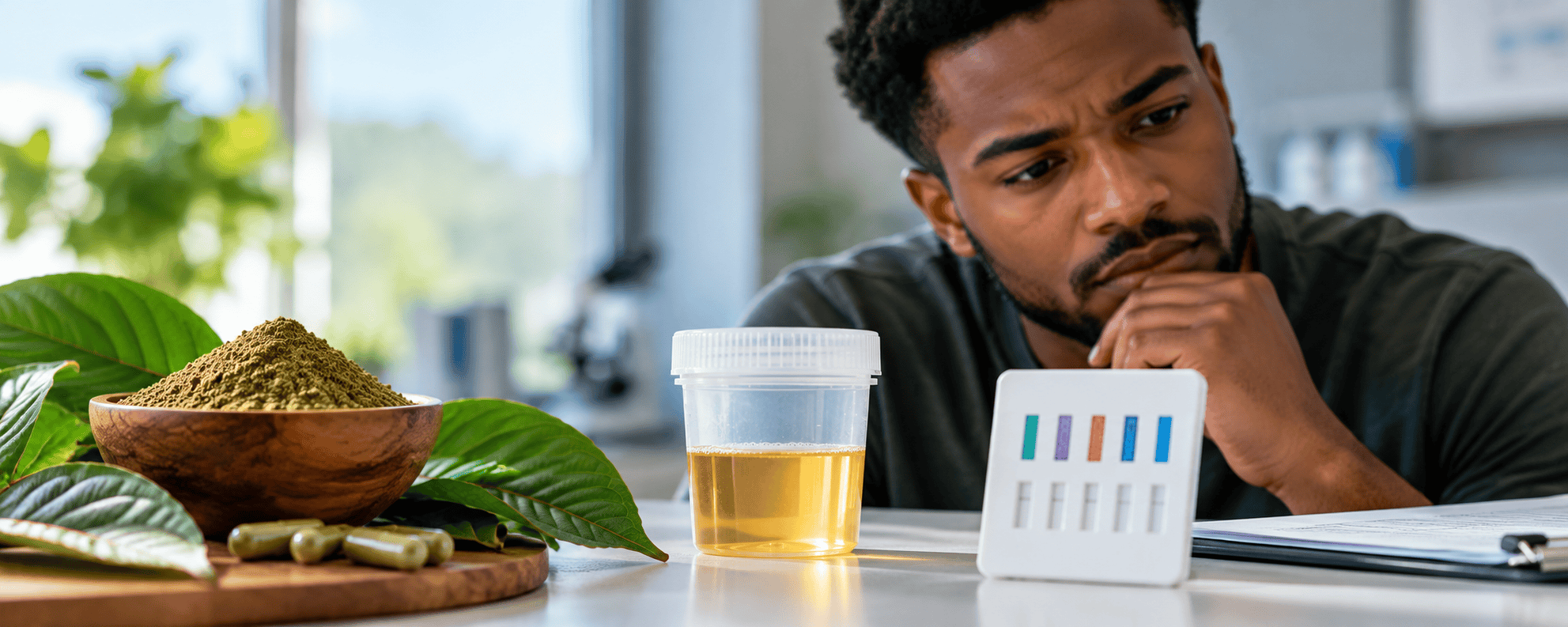
This guide answers a direct question: will kratom show up on a drug screening? The short answer is that it depends entirely on the type of test ordered. Standard drug panels are not built to detect kratom’s active compounds, mitragynine and 7-hydroxymitragynine. Only specialized, kratom-specific tests can identify its presence. The article covers what kratom is, the many forms it’s sold in today (pills, shots, beverages, vapes, and branded extracts), its shifting legal status across the U.S., and why its opioid-receptor activity makes it both effective and risky. It closes by encouraging readers to confirm their exact test panel and offers support for anyone whose kratom use has become difficult to manage, pointing them toward treatment resources at Royal Life Centers at Sound Recovery.
If you have a drug screening coming up and you’ve been using kratom, you’re probably searching for a straight answer. The truth is a little more nuanced than a simple yes or no, but it doesn’t have to stay confusing. Once you understand how drug panels are built and what kratom actually is, you’ll know exactly what questions to ask before your test date.
This guide walks through what kratom is, the different forms it comes in, its legal status, why it interacts with the body the way it does, and—most importantly—what determines whether it shows up on your specific screening. We’ll also touch on what to do if kratom use has become something more than casual, because that’s a conversation worth having honestly.
What Is Kratom?
Kratom is a plant-based substance derived from the leaves of Mitragyna speciosa, a tree native to Southeast Asia. For generations, communities in Thailand, Indonesia, and Malaysia have used kratom leaves for their stimulant and sedative properties, often chewing them or brewing them into teas. Today, kratom has found a much larger audience in the United States, where it’s marketed as a natural way to manage pain, boost energy, or ease anxiety. Learn more about what kratom is and why people use it here.
At low doses, kratom tends to act as a mild stimulant. At higher doses, its effects shift toward sedation, similar to what you might feel from an opioid. This dual nature is part of what makes kratom so widely used, and also part of what makes it worth understanding before you use it, especially if a drug test is on the horizon.
Forms of Kratom Being Used Today
Kratom has moved well beyond the traditional leaf-and-tea preparation. Modern kratom products come in several convenient formats, each offering a different dosing experience.
- Kratom pills: Pre-measured capsules containing powdered kratom leaf. These are popular among people who want a consistent, easy-to-track dose without the bitter taste of raw kratom powder.
- Kratom shots: Concentrated liquid extracts sold in small bottles, often found at gas stations and smoke shops. Kratom shots tend to deliver a more potent, fast-acting effect than capsules.
- Kratom beverages: Ready-to-drink kratom teas and sodas that have grown in popularity as a more casual, social way to consume kratom.
- Kratom vapes: A newer category. Kratom vape products and kratom vape pens deliver kratom extract through inhalation, which some users report as producing faster effects, though this method is less studied than others.
- Opia kratom: A specific branded kratom product line that has gained attention in the market, often marketed alongside other concentrated kratom extracts.
Regardless of the format, the active compounds are the same: mitragynine and its metabolite, 7-hydroxymitragynine. That consistency matters when we get to the testing question below.
Is Kratom Legal?
Kratom occupies a legal gray area in the United States. At the federal level, kratom is not currently classified as a controlled substance, meaning the Drug Enforcement Administration (DEA) has not scheduled it, despite considering doing so in the past.
However, is kratom legal depends heavily on where you live. Several states and municipalities have passed their own restrictions:
- States that have banned kratom outright include Alabama, Arkansas, Indiana, Rhode Island, Vermont, and Wisconsin.
- Some cities and counties within otherwise kratom-friendly states have enacted local bans, including several jurisdictions in Florida, Illinois, and California.
- Many states have adopted the Kratom Consumer Protection Act, which regulates how kratom is manufactured and labeled rather than banning it.
Choose to check your state and local laws directly if you’re unsure, since kratom’s legal status can change and enforcement varies by jurisdiction. This patchwork of regulation is one reason kratom isn’t automatically included on standard drug panels: testing labs build their panels around substances with consistent legal classification, and kratom simply doesn’t fit that mold nationally.
Is Kratom an Opioid?
This is one of the most common—and important—questions people ask. Technically, no: kratom is not derived from the opium poppy, so it isn’t classified as an opioid in a botanical sense. But functionally, the answer gets more complicated.
Mitragynine and 7-hydroxymitragynine, kratom’s primary active compounds, bind to the same mu-opioid receptors in the brain that drugs like morphine and oxycodone activate. This is why is kratom an opioid comes up so often: at higher doses, kratom can produce opioid-like pain relief and euphoria, and regular use can lead to physical dependence and withdrawal symptoms that resemble opioid withdrawal.
According to the U.S. Food and Drug Administration (FDA), kratom’s effects on opioid receptors are a primary reason the agency has raised safety concerns about the substance. This opioid-receptor activity is also the reason kratom shows up specifically on tests designed to detect opioid-receptor agonists, rather than on tests built for classic opiates like heroin or codeine.
How Drug Screenings Work: Standard Panels vs. Specialized Tests
To understand whether kratom will show up on your test, it helps to understand how drug panels are actually built.
Standard panels (5-panel and 10-panel tests) are designed to detect the substances most commonly regulated by federal workplace guidelines and the Substance Abuse and Mental Health Services Administration (SAMHSA). These typically screen for:
- Marijuana (THC)
- Cocaine
- Opiates (codeine, morphine, sometimes heroin metabolites)
- Amphetamines/methamphetamine
- Phencyclidine (PCP)
10-panel tests add a few more categories, such as benzodiazepines, barbiturates, methadone, and propoxyphene.
Specialized tests, by contrast, are built to detect specific compounds outside the standard list. These are ordered when there’s a particular reason to look for a substance that a standard panel wouldn’t catch, such as a synthetic opioid, a designer drug, or in this case, kratom.
Choose to think of it this way: a standard panel casts a wide net for the most commonly abused substances, while a specialized test is a targeted search for one specific compound. Kratom falls into the second category.
Are you struggling with substance abuse and mental illness?
Royal Life Centers at Sound Recovery is here to help you recover. Because We Care.
Does Kratom Show Up on a Standard Drug Test?
Here’s the direct answer: no, a standard kratom drug test result won’t appear on a typical 5-panel or 10-panel screening. Mitragynine and 7-hydroxymitragynine are structurally distinct from the opiates and synthetic opioids that standard panels are calibrated to detect. Even the opiate category on a standard panel is looking for specific metabolites of morphine and codeine, not kratom’s unique alkaloids.
This means someone could pass a standard pre-employment or routine workplace drug screening while having kratom in their system. Choose to keep in mind, though, that this is changing. As kratom use has grown and safety concerns have increased, more testing laboratories now offer kratom-specific add-on panels, and some employers and treatment programs are beginning to request them.
Kratom-Specific Testing: When and Why It’s Ordered
A dedicated kratom drug test is a urine, blood, or hair test specifically designed to detect mitragynine and 7OH kratom (7-hydroxymitragynine) metabolites. These tests use methods like liquid chromatography-mass spectrometry (LC-MS) or immunoassay screening calibrated specifically for kratom’s alkaloids.
Kratom-specific testing is typically ordered under these circumstances:
- Substance use treatment programs: Facilities that treat opioid use disorder often screen for kratom specifically, since it can be used as a substitute for opioids or can complicate withdrawal management.
- Suspected impairment: If someone shows signs of impairment that don’t match standard panel results, a physician or employer may order a broader specialty screen.
- Legal or custody proceedings: Courts may request expanded testing when kratom use is a documented concern.
- Pain management or psychiatric care: Physicians managing patients on other medications may test for kratom to check for interactions, particularly with the rise of 7OH kratom products, which are more concentrated and potent than traditional kratom leaf.
Choose to note that 7OH kratom in particular has drawn increasing regulatory attention because of its higher potency and closer resemblance to traditional opioids in its effects. Some kratom-specific panels test for this metabolite separately from mitragynine to capture a fuller picture of use.
How to Find Out What Panel Has Been Ordered
Since the entire answer hinges on which test you’re taking, the most useful thing you can do is find out directly. Here’s how:
- Ask the ordering party directly. Whether it’s an employer, a court, a probation officer, or a treatment provider, ask specifically whether the panel includes kratom, mitragynine, or 7-hydroxymitragynine.
- Request the panel name or code. Standard panels usually have a clear name, such as “SAMHSA 5-panel” or “extended 10-panel.” If kratom isn’t listed by name, it’s likely not included.
- Ask the testing laboratory. Labs like Quest Diagnostics and LabCorp can confirm exactly which substances a given panel screens for, since panel composition can vary by client and by order.
- Be upfront about your use. If you’re in a treatment or medical setting, disclosing kratom use helps your care team interpret results accurately and avoid confusion with other substances.
Confirming the panel ahead of time removes the guesswork and helps you understand exactly what to expect from your results.
What to Do If You’re Struggling With Kratom Use
For many people, kratom starts as a way to self-manage pain, anxiety, or opioid withdrawal. But because kratom acts on the same receptors as opioids, regular use can lead to physical dependence, tolerance, and a withdrawal syndrome that feels remarkably similar to opioid withdrawal. If you’ve noticed that you need more kratom to feel normal, that you feel sick without it, or that you’re using it to avoid withdrawal rather than for any lift it once gave you, it’s worth taking that seriously.
You’re not alone in this, and there is no shame in asking for support. Royal Life Centers at Sound Recovery, located in Lacey, Washington, offers substance abuse treatment designed to address the physical and emotional layers of dependence, including cases involving kratom and other substances that affect the opioid receptors. Our team treats every guest with the individualized, compassionate care that recovery requires. Learn more about how we approach drug addiction treatment, or read about what to know when searching for addiction treatment in Lacey, WA.
Know Your Test, Know Your Options
Whether kratom shows up on your drug screening comes down to one simple factor: what the test was designed to detect. Standard panels won’t catch it. Specialized kratom testing, ordered specifically to look for mitragynine and 7OH kratom, will. The smartest step you can take before your screening is to confirm exactly what panel has been ordered, so you’re not left guessing.
And if you find that kratom has become harder to put down than you expected, reaching out for guidance is a sign of strength, not weakness. Royal Life Centers at Sound Recovery welcomes every guest with the same warmth and respect, because recovery works best when you don’t have to navigate it alone. You can begin the admissions process today, or verify your insurance to see what coverage may be available to you. Because We Care.
Frequently Asked Questions
Does kratom show up on a standard 5-panel or 10-panel drug test?
No. Standard panels are calibrated to detect substances like THC, cocaine, opiates, amphetamines, and PCP. Kratom’s active compounds, mitragynine and 7-hydroxymitragynine, are structurally different and require a specialized test to detect.
How long does kratom stay in your system?
Kratom’s metabolites can generally be detected in urine for up to a week with regular use, though this varies based on dosage, frequency of use, metabolism, and the specific testing method used.
Is kratom legal where I live?
It depends on your state and local jurisdiction. Kratom is not federally scheduled, but several states, including Alabama, Arkansas, Indiana, Rhode Island, Vermont, and Wisconsin, have banned it outright, and some cities have local restrictions even in states where it remains legal.
Why would someone order a kratom-specific drug test?
Kratom-specific testing is typically ordered by substance use treatment programs, physicians managing pain or psychiatric medications, courts, or employers who have a specific reason to screen for kratom, particularly its opioid-receptor activity.
What should I do if I think I’ve developed a dependence on kratom?
Reach out to a treatment provider for an honest conversation about your use. Because kratom interacts with opioid receptors, withdrawal can be uncomfortable, and professional support, like the programs offered at Royal Life Centers at Sound Recovery, can make the process safer and more manageable.
- “FDA and Kratom.” FDA, U.S. Department of Health and Human Services, 2025. FDA and Kratom.
- U.S. Food and Drug Administration. “Products Containing 7-OH Can Cause Serious Harm.” FDA, U.S. Department of Health and Human Services, 2025. FDA 7-OH Consumer Update.
- U.S. Food and Drug Administration. 7-Hydroxymitragynine (7-OH): An Assessment of the Scientific Data and Toxicological Concerns Around an Emerging Opioid Threat. U.S. Department of Health and Human Services, 2025. FDA Scientific Assessment of 7-OH.
- National Center for Complementary and Integrative Health. “Kratom.” NCCIH, National Institutes of Health, U.S. Department of Health and Human Services. NIH/NCCIH Kratom Overview.